HUGELY IMPORTANT NEWS! In the the FAA is making a big push to get AoA indicators installed in General Aviation aircraft. The FAA has published an April 2015 AOA Addendum to the Instrument Flying Handbook. Short and to the point, it should be truly valuable to any pilot..and...in October 2015, they updated the FAA Currency Requirements and Guidance for the Flight Review and Instrument Proficiency Checkguide with a new emphasis on AOA (see page 16, Paragraph 4-3d) How To Review AoA during IPC flights.
ABS NEWS November and December 2015 "Why AOA? How We Fly With an AOA", by Aitken, Rosen, Scott, Stovall
NOTE: My permission to post and your permission to read here does not include permission to reprint elsewhere. For that, please ask each copyright owner, the magazine, itself. Thanks.
October 2015: Larry Anglisano in Aviation Consumer (10/15) reviews the Safe Flight SCc AoA system. You really ought to subscribe to Aviation Consumer Magazine but you can read the same Safe Flight SCc AoA article on a free PDF here, courtesy of Larry Anglisano, Editor. Or, watch his AoA Aviation Consumer video
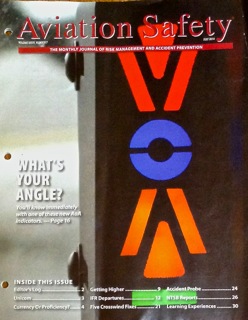 July 2014 Here's an Aviation Safety Magazine front cover article by Dave Higdon July 2014 Here's an Aviation Safety Magazine front cover article by Dave Higdon
"Not Just For Jets Anymore".
Jim Hanson has landed King Air B-90s with 9 pax on 2400' of grass at Northwest Angle--Lake of the Woods, MN--but with 500# of fuel aboard (for takeoff, in two trips). These B-90s all had the then-optional simplified AoA---(similar to the SC100)---on the top of the panel He says "Yes, it was crude and not TSO'd--but it gave a good indication of the lift reserve available--much like the AoAs the FAA has now approved for advisory use. " and Jim wrote a longer article on AoA (read here).
Read the full FAA inFO document here.
Dec 2013 our friend David F. Rogers, PhD, ATP, Professor of Aerospace Engineering (Emeritus) Annapolis, MD published a new series of six articles on Angle of Attack at his Thanks for the huge effort, Dr. Dave!
August 2013 Embry-Riddle installs AoA fleet- wide on 61 training aircraft!
May 2013 with the kind permission of Paul Bertorelli...
An Oldie but a Goodie, from the year 2000, by Boeing Aircraft is a very complete discussion of Alpha sensors/displays. Especially, Boeing points out that AoAs work best as we approach the stall; that simpler is better; that training is required to understand the display. All that relates directly to general aviation. Boeing writes...
"AoA can be used for many indications on the flight deck to improve flight crew awareness of airplane state relative to performance limits. Dedicated AoA indicators have been used on military aircraft for many years, but this form of display has not been used often on commercial [or general aviation] airplanes ...
"... Recent accidents and incidents have resulted in new flight crew training programs for upset recovery and terrain avoidance, and these in turn have heightened industry interest in AoA as a useful flight parameter ..."
So, if we in light aircraft dismiss the high altitude jet-speed issues and the swept wing / leading edge effects, and forget about tail strike prevention (I admit I had never considered that one!), what do we have left that's transferable and good for GA?
As I read it, it's "reliable early warning of stall", "a Vref indicator", and..."training is required in 'How To Fly Alpha' ". I especially liked their "We must use a crosscheck of AoA and ASI".... and so, I have come to fly mine using the techniques explained here.
"AOPA PILOT" March 2012, by Dave Hirschman.
or you can also read it here
"AOPA - CFI to CFI" AOPA's Chief Pilot JJ Greenway was learning how effective Alpha can be in light general aviation aircraft so he earned full re-current qualification in my King Air 90. He was an American Airlines Check Airman for the Boeing 767, but he is also a humble man, so he wrote this "CFI to CFI" article afterwards. Today he is the President of AVEMCO Insurance Company.
In this extraordinarily helpful December 2011 FAA clarification letter, the FAA Small Aircraft Directorate explains that installation is a "minor alteration" on the vast majority of light general aviation aircraft.
Please join in our thanks to the FAA Small Aircraft Directorate.
Jeb Burnside and Fred Scott (mostly Jeb!) in "Aviation Safety", June 2011
(posted here by permission)
Reprints? Please inquire of Jeb Burnside, Editor, Aviation Safety Magazine <avsafetymag@gmail.com> stating where/when/how something might be used.
Dave Hirschman in "AOPA Pilot", June 2011
(posted here by permission)
"AoA for GA"
"Angle of attack moves from academic to actual"
Charles Lloyd in "The Cessna Flyer" April 2011
(posted here by permission)
Part One: "AoA, Who Needs It, and What Is It?
Charles Lloyd in "The Cessna Flyer" May 2011 his follow-up...
(posted here by permission)
Part Two: "Selecting, Installing, and Operating an AoA System"
Wondering about FAA Approval and Guidance? see: AIR100-14-110-PM01
Click here to begin reading the series: "Voices of those who know Alpha"
|